Astroshastra provides the products blessed by a Chinese Buddhist monks to add to the purity and integrity of each product. By walking that extra mile, we sincerely hope we have added to the overall value of each one of our products, and that the blessed products bring purity and joy into your home. Please browse through our on-line catalogue. We are constantly searching the world for suitable Positive Symbolism and Feng Shui related stock. If you can not find what you want, then suggest it to us and we shall do our best to find it for you.
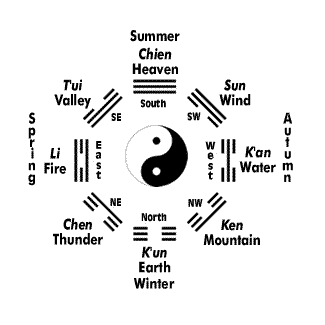
 Feng Shui is based on the principle of Yin and Yang, and the balancing of five elements, including fire, earth, metal, water and wood. A Feng Shui analysis of a building examines the surrounding environment, the building and how the people inside interact with the building, and it also looks at time-related factors such as the birthdates of occupants and the year the building was completed. Based on these factors, recommendations can be made on how to improve the relationship with the environment using the elements as remedies.
The recommendations can improve the lives of the occupants of the property. To do a Feng Shui reading, a practitioner uses a compass called a Lo-pan to determine the energy characteristics of a building. Calculations are done and remedies are prescribed in order to balance the energy
 Classical feng shui has a wealth of feng shui cures and feng shui charms for protection and good luck. The desire for protection should not come form fear, but from the basic understanding that there is a wide variety of feng shui energies all around us, and some of those energies are best left outside your own
There are several feng shui rules, or guidelines, when placing a tortoise as a feng shui cure in your home, your garden, or your office. The Tortoise is one of the four Celestial Animals, or Guardians in feng shui, which are the Green Dragon ( East ), the Red Phoenix ( South ), the White Tiger ( West ) and the Black Tortoise ( North.) They are considered guardians of good feng shui energy and the roots of their symbolism and feng shui use go deep to the feng shui beginnings, or the landscape school of feng shui. This bring us to the first feng shui use of turtles, or tortoises in feng shui, which is the feng shui use as a protection and energy strengthening cure when placed in the back of the house. This also means you can place a small tortoise at your back in the office, or in the back of your garden.The second use of the tortoise, particularly a black tortoise made from metal is in the North, as a feng shui energy enhancer for your career - it will help attract a smooth, grounding energy for your business projects and promotions in your career.The third feng shui use is to bring a stable, grounding energy to a feng shui area of your feng shui map, or Ba-gua that needs more protection and stability. You mentioned you have a stone tortoise close to the West-facing main door, which brings the energy of grounding (stone/Earth feng shui element) and protection to the main door. Good choice! If your wife chose this application of feng shui, be sure that the turtle is facing the main door. The fourth application is used in a slightly more advanced feng shui - as you might have in your case, too - when the feng shui tortoise is facing the best directions for the inhabitants of the home, and this is calculated by looking into the Kua number, the birth element and the current feng shui energies for the year.There are also feng shui tortoises with specific designs on their back, as well as made from different materials, or with additions, such as feng shui coins to attract more money, to improve health, etc, as well as feng shui terrapins, which should not be confused with feng shui turtles, as their feng shui use is slightly different.My advice, though, is not to worry. I am sure you do remember the approximate positioning of the turtle. If in doubt, make it face the main door, but definitely ask your wife if she placed it as a more advanced feng shui cure.

dragons come in many sizes and variations of materials and color. A green dragon, for example, is an excellent feng shui cure for the East - health feng shui area - of your home, while a golden dragon can be a great feng shui cure for wealth and abundance. Having a feng shui dragon in any part of your home is auspicious. Do not place the feng shui dragon in lower-energy areas, such as the bathroom, the closets or the garage, and do not have too many dragons in your home. Feng Shui-wise, the maximum recommended number of dragons in the home is 5. Also, do not place the dragon(s) too high, meaning not too high above the eye level. If you want to place the dragon in the love & relationships feng shui area, it is best to pair it up with the feng shui symbol of the phoenix, as dragon & phoenix together are the ultimate feng shui symbol of marital bliss. There are several ways to decide the best feng shui location and positioning of the dragon in your home. You can make your choice based on:
Your best/lucky directions. Will it look good/harmonious in your home (in relation to all the other elements/items you have) if it will face one of your feng shui best/lucky directions? You can find out your lucky directions by first calculating your Kua number.
The wealth star for the current year. (Check where the feng shui wealth star is located this year) The location of the feng shui wealth star changes every year, so you will have to change the dragon's facing direction, too. Ideally, you will place your feng shui dragon:
close to an open space, or in an open space
careful not to have the pearl in the dragon's claw facing toward the window or the door.
facing towards the house (to bring in the energy of wealth) but not feel cramped/restricted by facing a close wall.Dragons are powerful and magical feng shui creatures, give them a lot of breathing room and treat them with respect
Your best/lucky directions. Will it look good/harmonious in your home (in relation to all the other elements/items you have) if it will face one of your feng shui best/lucky directions? You can find out your lucky directions by first calculating your Kua number.
The wealth star for the current year. (Check where the feng shui wealth star is located this year) The location of the feng shui wealth star changes every year, so you will have to change the dragon's facing direction, too. Ideally, you will place your feng shui dragon:
close to an open space, or in an open space
careful not to have the pearl in the dragon's claw facing toward the window or the door.
facing towards the house (to bring in the energy of wealth) but not feel cramped/restricted by facing a close wall.Dragons are powerful and magical feng shui creatures, give them a lot of breathing room and treat them with respect